Document Reader - PDF Editor
- 3.7
- Rating
- 500.00K
- Installs
- Free
- Price
 Analysis by App-foxy
I know the small frustration this kind of tool is meant to solve: someone sends me a document, I need to open it immediately, and my phone either offers several unrelated apps or handles the file awkwardly. Document Reader - PDF Editor is aimed at making that moment simpler by putting document reading in one place. After spending time with it, I see it as a practical tools app for people who want a straightforward way to deal with documents on a phone, rather than a full desktop-style office suite.
My overall impression is positive but measured. The main benefit is convenience. Instead of treating every document as a separate problem, I can use one reader as a central point for opening and checking files. That matters when I am moving between messages, downloads, and folders throughout the day. The app is free, has an Everyone age rating, and comes from Popientip Yia. Its current version is 1.0.7, and it runs on Android 8.0 or later, so it remains accessible to many older devices.
Why a simple document reader can save real time
The recurring problem is rarely “I need advanced document production.” More often, it is “I need to see this file now.” A receipt, form, instruction sheet, application document, or work attachment can arrive at an inconvenient time, and switching between different viewers creates unnecessary friction. A dedicated document reader helps by giving that first task a clear destination.
You May Also Like

 Blood Strike: 2.5 Anniversary
Blood Strike’s Loadouts Turn Every Drop Into a Tactical Gamble
A close look at Blood Strike’s custom loadouts: how fast access to signature weapons reshapes its battle royale rhythm, rewards preparation, and narrows the gap between fights.

 Pandora - Music & Podcasts
Pandora’s Music Is Easy to Start, but Harder to Recover
Pandora’s strength is its low-effort path from a seed to a station. Its weak spot is how much confidence it asks you to place in connection, setup, and quiet recovery.

 8 Ball Pool
 Is Built on Rivalries, Rematches, and Routine
A close look at the rivalries, rematches, shared routines, and unanswered safety questions that turn a quick pool match into a persistent mobile community.

 Samsung Music
’s Quiet Strength Is Playing What You Already Own
Its reach comes less from spectacle than from dependable access to a personal library. That simplicity is both the app’s strongest retention engine and its ceiling.

 AccuWeather: Weather Radar
AccuWeather Review: A Quick, Clear Forecast for Everyday Decisions
For everyday plans, the best forecast is the one you can understand quickly. AccuWeather makes rain timing, radar, and local conditions easy to act on, with a few trade-offs.

 Hill Climb Racing
Why Hill Climb Racing Still Turns Crashes Into One More Run
A tiny car, a bumpy hill and one more upgrade: Hill Climb Racing keeps resurfacing because its simple chaos makes every near-miss feel personal.
More From Our News Desk



That focus is the strongest reason I would recommend trying it. I do not have to open a browser tab, search for an online converter, or install a separate viewer every time a document appears. For quick checks, the value is measured in fewer interruptions rather than dramatic new capabilities. The app earns its place when it makes a routine action feel predictable.
The store describes it as an all-in-one document reader, while the short description identifies it simply as a document reader. I think that distinction is useful. The app should be approached first as a reading utility, not automatically as a replacement for a complete office application. The title includes PDF Editor, but anyone expecting the depth of a desktop PDF workstation should keep expectations sensible and judge the editing experience by the exact task they need to complete.
Its audience is easy to identify. Students checking course material, renters reviewing agreements, travelers opening tickets or confirmations, and employees checking attachments can all benefit from a focused reader. It is also suitable for someone who does not want to learn a complicated interface just to inspect a file. On the other hand, people who regularly create polished documents, manage signatures, perform detailed redaction, or collaborate on files may be better served by a specialized productivity suite.
The first setup should be treated as a sorting exercise
When I first use a document utility, I do not begin by opening a random file. I first make sure I understand where my documents come from: downloads, messages, cloud storage, or local folders. That habit is especially useful here because the time saved later depends on whether I can quickly recognize the file I need. A document reader is only convenient when its library or opening workflow matches the way I already store files.
I recommend starting with three ordinary documents rather than a large collection. Choose one short file, one longer file, and one document that arrived through another app. This gives a more realistic sense of how quickly the reader helps in everyday use. It also exposes a common issue with document utilities: finding a file can take longer than viewing it if the phone’s storage is untidy.
A useful workflow is to rename important downloads before they disappear among generic filenames. “Document Reader - PDF Editor” cannot solve unclear file names, but it can become more useful when the files around it are organized. I keep temporary documents in a separate folder and remove them after checking them. That reduces the visual clutter that often makes mobile document apps feel slower than they really are.
Another practical tip is to test the app with the documents I actually receive, not only with a clean sample. A text-heavy form, a scanned page, and a file with several pages place different demands on a reader. This is one of the less obvious parts of evaluating an app like this: the best viewer is not necessarily the one with the most buttons, but the one that handles your normal files without making you rethink your routine.
Where it fits into an ordinary day
Imagine receiving a rental agreement while standing in a café. I would download it, open it in the reader, move through the pages, and check the sections I need before replying. The important advantage is not that the app turns the phone into a legal workstation. It is that I can inspect the document in the same place I handle other files, without delaying the decision until I reach a computer.
A similar situation happens with travel documents. A confirmation may be buried in an email or messaging conversation, and opening it quickly is more useful than building a permanent archive. I would use the app for the immediate check, then decide whether the document needs to be kept, shared, or deleted. This “open, verify, act, clean up” workflow keeps the reader from becoming another crowded storage area.
For students, the app can be useful when reading handouts away from a desk. The key advantage is portability: a phone is already available, and a dedicated reader reduces the temptation to keep several browser tabs open. I would not use it as my only study tool for heavy annotation or long research sessions, but it can handle the quick review between classes or while commuting.
At work, I see a good fit for attachments that only need a visual check. A colleague may send a form, a policy document, or a reference file that I need to read before responding. The reader helps separate that task from editing. That separation is valuable because many people waste time opening a powerful office suite when they only need to confirm a date, a paragraph, or a page count.
There is also a small but meaningful accessibility benefit in keeping document reading simple. Someone who rarely works with files may feel more comfortable with a focused tool than with a large application full of unfamiliar controls. The Everyone rating makes it suitable for a broad audience, although suitability in practice still depends on the user’s comfort with file storage and mobile navigation.
What friction it removes, and what it does not
The first friction removed is app switching. A document arrives, and I have a clear place to send it. The second is uncertainty. Instead of wondering which installed application will interpret the file correctly, I can begin with a tool designed around document reading. The third is delay. For a quick inspection, opening a dedicated reader is usually more direct than finding a desktop computer or using an online service.
That convenience becomes more valuable when repeated. Saving a minute once is unremarkable; avoiding the same small interruption several times a week is different. This is why I judge the app primarily by workflow rather than by a long feature checklist. If it helps me open and inspect common documents without distracting steps, it is doing the job I want.
There is a useful trade-off here. A focused document app may feel lighter and easier than a broad office suite, but it will not necessarily offer the same depth for document creation, collaboration, or professional editing. I would choose this reader when reading is the center of the task. I would choose a full office application when I need to build a document from scratch, revise complex layouts, or move repeatedly between writing and formatting.
Compared with opening files directly from a file manager, the advantage is specialization. A file manager is excellent for moving, renaming, and deleting items, but it is not always the most comfortable place to read. Compared with a browser-based viewer, a dedicated app can feel more immediate for local documents and avoids turning a simple check into a web workflow. Compared with a professional PDF suite, this app is more approachable, but likely less suitable for demanding document operations.
One of my favorite practical habits is to use the reader as a checkpoint rather than a permanent workspace. I open the file, confirm that it is the correct version, note what action is needed, and then return to the app where the task belongs. For example, I might read a form here, then fill in information elsewhere. This prevents the document viewer from becoming a substitute for every other tool on the phone.
Questions I would consider before installing it
If you are wondering whether it is suitable for an older phone, the minimum operating system is Android 8.0 or later. That makes it a reasonable candidate for devices that are not running the newest Android release. Still, I would leave enough free storage for the documents themselves and avoid judging any reader solely by the app installation; large or image-heavy files can be demanding regardless of the viewer.
If you are asking whether it is free to try, yes, the app is offered at no cost. That makes experimentation easy: install it, open the files you normally receive, and see whether the workflow feels quicker than your current method. I would not switch based only on the promise of an all-in-one label. My decision would depend on whether it handles my real documents comfortably and whether its editing tools match my expectations.
If you mainly need to read PDFs, this is the clearest use case. If you need advanced editing, I would test that requirement separately before relying on it for important work. A reader can be excellent at viewing while still being the wrong choice for detailed page rearrangement, professional markup, or document production. The title suggests editing is part of the experience, but the sensible approach is to treat advanced work as something to verify through actual use.
If you are concerned about whether other people use it, the app has passed one hundred thousand installs and holds an average rating of 3.8 from 229 ratings, alongside 28 written reviews. Those figures suggest a real user base and a generally mixed-to-positive reception, rather than universal approval. I read that as a reason to try it with a normal workflow, not as a guarantee that every device or file type will behave identically.
Where the experience can become less comfortable
The biggest limitation is the natural boundary between convenience and depth. A phone is excellent for checking a document, but less comfortable for long editing sessions. Even when an app includes editing functions, working precisely on a small screen can feel slower than using a computer. I would use this app for quick corrections or checks only if those controls feel clear, and I would move serious document production to a larger-screen alternative.
File organization can also remain a weak point. A reader does not automatically replace good storage habits. If downloads, message attachments, and duplicate versions are scattered across the phone, the first challenge may still be locating the right file. New users should not mistake a document-focused interface for an automatic filing system. Keeping filenames and folders tidy will have a larger effect on daily speed than repeatedly changing viewer settings.
Another trade-off concerns concentration. A phone reader is convenient, but notifications and other apps are always nearby. For a short form or confirmation, that is not an issue. For a long report, I may prefer a tablet, computer, or dedicated reading environment. The app removes the barrier to opening a file, but it cannot remove the distractions built into the device itself.
I would also be careful with important documents. Before depending on any mobile editor for a final submission, I would reopen the finished file and inspect every page, especially if the document contains forms, images, or carefully arranged text. That is not a criticism unique to this app; mobile document workflows can introduce surprises when a file is changed or shared. A quick final check is a small price for avoiding an embarrassing submission.
My verdict after using it as a daily utility
Document Reader - PDF Editor is most convincing when I use it for what many people actually need: opening documents quickly, checking their contents, and deciding what to do next. The free price, broad age rating, support for Android 8.0 and later, and clear tools focus make it approachable. Popientip Yia has positioned it in a useful space for people who want less friction around ordinary document handling.
I would recommend it to students, casual readers, families, and workers who frequently receive documents but do not need a complete office suite every day. It is especially worthwhile if your current routine involves repeatedly searching for a viewer or opening files through unrelated apps. The time saved comes from having a dependable starting point, not from replacing every document tool on your phone.
I would skip it, or at least compare it carefully with a more specialized alternative, if your work depends on advanced PDF production, precise editing, collaboration, or a highly controlled document archive. In those situations, the broader capabilities of a dedicated professional application may justify a more complicated interface. This app is better understood as a convenient everyday reader with editing ambitions than as a complete desktop replacement.
With an average rating of 3.8 and more than one hundred thousand installs, it has enough visibility to be worth testing, while the rating also encourages realistic expectations. My final advice is simple: install it, open the files you genuinely use, and measure the number of steps between receiving a document and understanding it. If that path becomes calmer and faster, Document Reader - PDF Editor is a sensible addition to your Android tools folder. If your needs begin after reading—complex editing, publishing, or teamwork—keep a stronger specialist app nearby.
FAQs for Document Reader - PDF Editor
01What file formats does Document Reader - PDF Editor support?
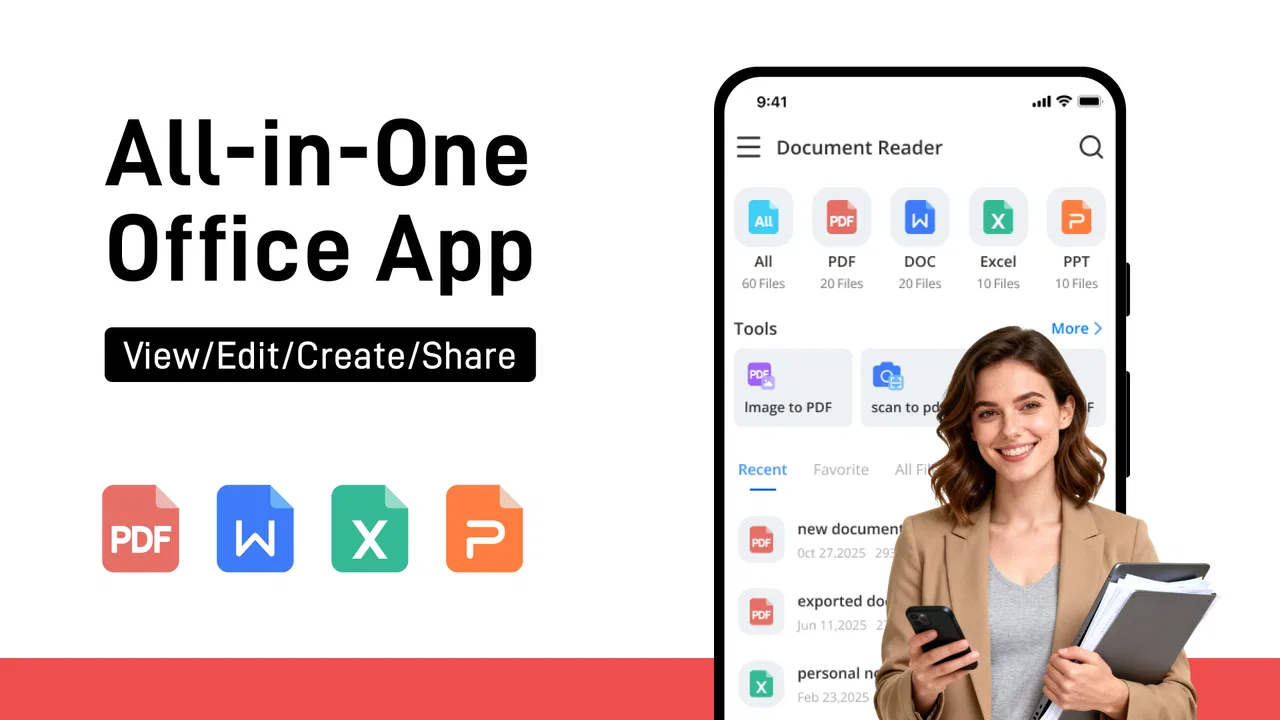
Document Reader - PDF Editor supports a wide range of file formats, including PDF, DOC, DOCX, PPT, PPTX, XLS, XLSX, and TXT. This makes it versatile for users who need to view or edit various types of documents on their mobile devices without switching between different apps.
02Is Document Reader - PDF Editor free to use?
The app offers a free version with basic features, allowing users to view and perform simple edits on documents. However, advanced features such as annotations, cloud storage integration, and ad removal may require a subscription or a one-time purchase, depending on the app’s pricing model.
03How secure is Document Reader - PDF Editor for handling sensitive documents?
Document Reader - PDF Editor prioritizes user privacy and security. It includes features like password protection for PDFs and secure cloud storage options. However, users should always ensure they are using the latest version of the app for optimal security updates and practices.
04Can I edit PDFs with Document Reader - PDF Editor?
Yes, Document Reader - PDF Editor allows for basic PDF editing, such as adding text, images, and annotations. For more complex editing tasks, such as reordering pages or modifying text within the document, users might need to upgrade to a premium version to access these advanced tools.
05Does Document Reader - PDF Editor offer cloud integration?
Yes, the app integrates with popular cloud services like Google Drive, Dropbox, and OneDrive. This feature allows users to easily access, edit, and save documents directly to and from the cloud, ensuring that their files are synced and accessible from multiple devices.
Pros
- Intuitive interface makes navigation easy.
- Supports a wide range of document formats.
- Offers powerful editing tools for PDFs.
- Allows cloud integration for file access.
- Offers offline mode for editing anywhere.
Cons
- Free version has limited features.
- Occasional ads can disrupt workflow.
- Some features require subscription.
- Editing large files may lag slightly.
- Limited customization for annotations.

Document Reader - PDF Editor
Gallery